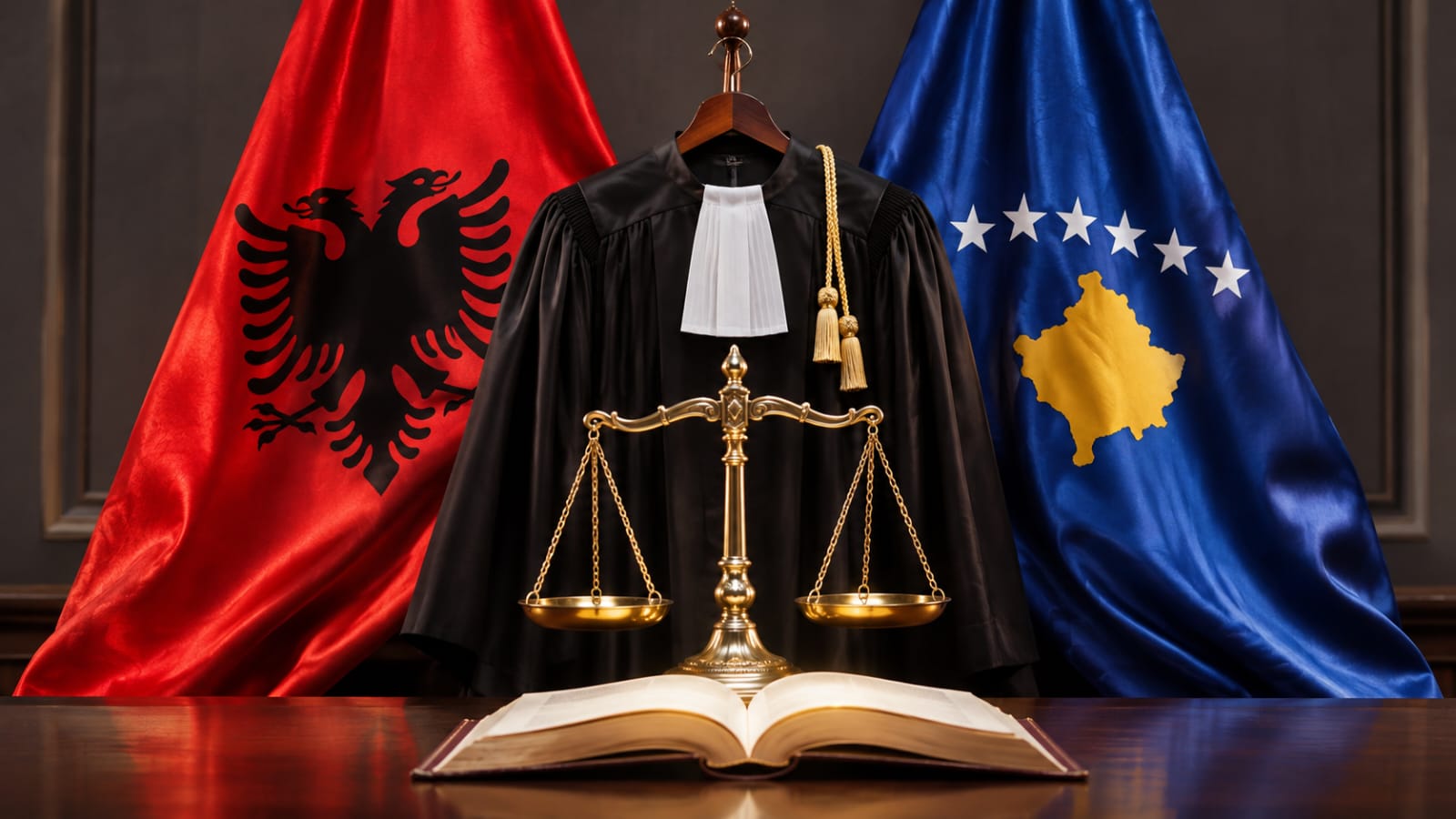
ONE NATION, TWO LEGAL SYSTEMS, A RIGHT AWAITING IMPLEMENTATION
Mutual recognition of the legal profession between Albania and Kosovo: from international agreement to institutional responsibility for its implementation.
Petani Law & Tax | Legal and Institutional Analysis
An Agreement That Must Become Reality
In recent years, Albania and Kosovo have taken significant steps toward aligning their economic, institutional, and legal systems. One initiative of particular importance to the justice system is the agreement on the mutual recognition of the right to practice as a lawyer and as a mediator in dispute resolution.
Signed on July 6, 2023, and ratified in accordance with the relevant procedures, this agreement aims to enable professionals licensed in one state to practice their profession in the other, provided they adhere to established professional conditions and standards.
However, despite its significance and the time that has elapsed since its signing, the full implementation of this agreement within the legal profession remains an unresolved issue. This situation raises a question that extends beyond the narrow professional interests of lawyers:
Can an international commitment be considered fulfilled simply because it has been signed and ratified, if the responsible institutions fail to translate it into an effective right for citizens?
The answer must be sought not only in the text of the agreement but also in the principle of legal certainty, the obligation for institutional cooperation, and the public interest that lies at the core of the legal profession.
Mutual recognition is not automatic or unconditional recognition.
From a legal perspective, the agreement should not be interpreted as a mechanism that automatically grants every lawyer an unconditional right to practice their profession in the other jurisdiction.
Rather, it establishes a system of mutual recognition, contingent upon the verification of professional knowledge and compliance with the legislation of the state where the profession is to be practiced.
Article 5 of the agreement provides for alternatives to verify knowledge of the applicable law, including professional testing, completion of relevant training, or the regular and effective practice of the profession in cooperation with a law firm in the other state for a period of no less than six months.
Such a mechanism aims to strike the necessary balance between professional mobility and ensuring the quality of legal services.
Furthermore, Article 40 of Law No. 04/L-193 on the Legal Profession in Kosovo explicitly provides for the possibility of lawyers from other states practicing the profession on the basis of reciprocity, while defining the roles of the Ministry of Justice and the Bar Association in this process.
On the other hand, Article 6 of the Albanian Law No. 55/2018, "On the Legal Profession in the Republic of Albania," recognizes the possibility of practicing the profession outside Albanian territory, in accordance with the legislation of the respective state or international agreements.
Consequently, cooperation between the two legal systems is not an alien concept to the respective national legislations. The issue requiring a solution is the establishment of clear, proportionate, and enforceable procedures that render reciprocity a practical reality rather than merely a stated principle.
Citizens and businesses are the primary beneficiaries.
The mutual recognition of the legal profession is often viewed primarily from the perspective of professionals seeking to expand their practice. In reality, its most significant benefit concerns the individual citizen and their effective access to justice.
A citizen of Kosovo who engages in economic activity, holds assets, or faces a legal dispute in Albania should be able-subject to legal requirements-to choose the same lawyer to whom they have entrusted their interests for years.
The same logic applies to an Albanian citizen or entrepreneur who has investments or legal dealings in Kosovo.
When implemented with appropriate safeguards, mutual recognition can ensure continuity in legal representation, reduce coordination costs, facilitate the management of cross-border cases, and broaden the options available for selecting legal counsel. This takes on particular significance in commercial relations, investments, international contracts, family and inheritance matters, as well as in legal proceedings involving entities or interests in both states.
At a time when economic relations between Albania and Kosovo are developing, legal services should not remain constrained by administrative barriers that can be addressed through institutional cooperation.
Certainly, mutual recognition does not eliminate the need to be familiar with local legislation, nor does it automatically guarantee lower costs for every client. However, it creates the conditions for greater professional competition, specialization, and choice.
It is precisely this that makes the agreement an instrument of public and economic importance, extending beyond the individual interests of lawyers.
The independence of bar associations and the responsibility for cooperation
One of the aspects that has accompanied discussions regarding the implementation of the agreement is the institutional autonomy of the bodies that represent the legal profession.
The Kosovo Bar Association has publicly expressed reservations regarding the manner in which it was involved in the drafting of the agreement, as well as concerns about the preservation of the competencies derived from the relevant legislation.
These concerns deserve serious consideration.
The independence of the legal profession is an essential guarantee for the functioning of the rule of law. It cannot be diminished by a cooperation agreement, nor can it be supplanted by administrative interventions that infringe upon the competencies of professional bodies.
Nevertheless, institutional autonomy and international cooperation are not mutually exclusive principles; on the contrary, they should complement one another.
The right of professional bodies to retain their competencies must be accompanied by the responsibility to contribute to solutions that foster the development of the profession.
The agreement specifically provides for the drafting of technical arrangements between professional institutions to regulate matters such as membership, contributions, professional liability insurance, continuous professional development, disciplinary proceedings, and inter-institutional communication.
These are not issues that render reciprocity impossible. Rather, they are legal and organizational matters that require mutually agreed-upon solutions. For this reason, every concrete obstacle must be identified, legally substantiated, and accompanied by a proposal for its resolution.
A lack of consensus must not be allowed to become a permanent situation, in which a right provided for by an agreement remains without effective implementation mechanisms.
From international agreement to the obligation for institutional action
The ratification of an international agreement is an act with legal consequences, not merely a declaration of political intent.
Within the Albanian constitutional system, Article 122 of the Constitution defines the status of ratified international agreements within the domestic legal order, as well as the conditions for their implementation.
However, a distinction must be made between the obligation to respect an agreement and the immediate exercise of a right that requires supplementary rules.
When an agreement provides for further implementation mechanisms, the competent authorities must cooperate in their preparation, in compliance with the law and their respective institutional mandates.
Information regarding inter-institutional communications indicates that the Albanian side has submitted proposals concerning the modalities for recognition. Meanwhile, it remains necessary for both professional institutions to ensure transparency regarding the progress of the process, the issues upon which agreement has not yet been reached, and the steps to be taken toward its conclusion.
A functional solution would require the adoption of a joint protocol establishing clear procedures for professional recognition, the necessary documentation, the verification of qualifications, registration, the rights and obligations of lawyers, as well as cooperation in disciplinary matters.
At the same time, it should be examined whether effective implementation requires the harmonization of professional statutes or specific legislative amendments.
This approach would ensure that the agreement is implemented without compromising the independence of either chamber and without lowering the standards of legal protection.
Two states, one nation, and the historical responsibility of institutions
The relationship between Albania and Kosovo cannot be analyzed solely within the traditional framework of cooperation between two states.
It carries a distinct historical, linguistic, cultural, and national dimension.
Albania and Kosovo are two independent states, each with its own constitution, legislation, and institutions. This is a legal reality that must be respected. Yet, they are also part of the same Albanian national space, bound together by history, language, tradition, and human ties.
History has created state borders and separate legal systems. Today’s institutions have the opportunity-without compromising these borders or the sovereignty of each state-to build bridges of cooperation that serve the citizens.
National cooperation is not measured solely by ceremonial declarations, official meetings, or signed agreements.
It is measured by the rights that citizens can truly exercise, by the obstacles that institutions succeed in removing, and by the results that their efforts yield.
In this sense, the mutual recognition of the right to practice law represents something more than just an agreement on professional mobility.
It serves as a concrete opportunity to bring the two justice systems closer together, to facilitate the exchange of professional experience, and to gradually establish common standards for legal services.
It is not necessary for Albania and Kosovo to share a single legal system in order to guarantee their respective professionals the opportunity to practice in each other’s jurisdictions-based on the rule of law, reciprocity, and shared standards of accountability.
This is precisely where the national significance of this agreement lies: not in the merging of institutions, but in their capacity to cooperate for the benefit of a human and professional space defined by ties that run far deeper than any administrative border.
Conclusion: Time to Implement the Agreement
More than three years after its signing, the agreement on the mutual recognition of the legal profession between Albania and Kosovo deserves to be brought back to the forefront of the attention of the responsible institutions. The Albanian Bar Association and the Kosovo Bar Association have the opportunity to launch a joint initiative to finalize technical modalities, address remaining obstacles, and establish a clear implementation timeline.
This process should be conducted with transparency, mutual institutional respect, and the participation of legal experts and representatives of the profession.
For Petani Law & Tax, the mutual recognition of the right to practice law is a development that deserves support; it strengthens professional cooperation, expands access to justice, and creates more favorable conditions for citizens and businesses in both countries.
Ultimately, the issue is not merely whether a lawyer from Albania can practice in Kosovo, or whether a lawyer from Kosovo can practice in Albania.
The core question is whether our institutions are prepared to transform a shared commitment into a functional legal reality.
History has divided the Albanian nation across different jurisdictions. While institutions cannot change history, they can-and must-build the cooperation that history has hindered for so long.
For while borders define the jurisdictions of states, they should not create unnecessary barriers to justice. A ratified agreement must not remain merely a promise on paper. It must be transformed into a right that is exercised.
---
PETANI LAW & TAX
Legal Analysis & Institutional Affairs
Durrës | Tirana | Pristina
www.petani-lawfirm.com
Photos